
Why Your New Year's Resolutions Never Stick: How To Create Lasting Change
Why willpower, winter biology, habit inertia, and cultural conditioning sabotage your resolutions every year - and how to replace short-term goals with permanent lifestyle change.

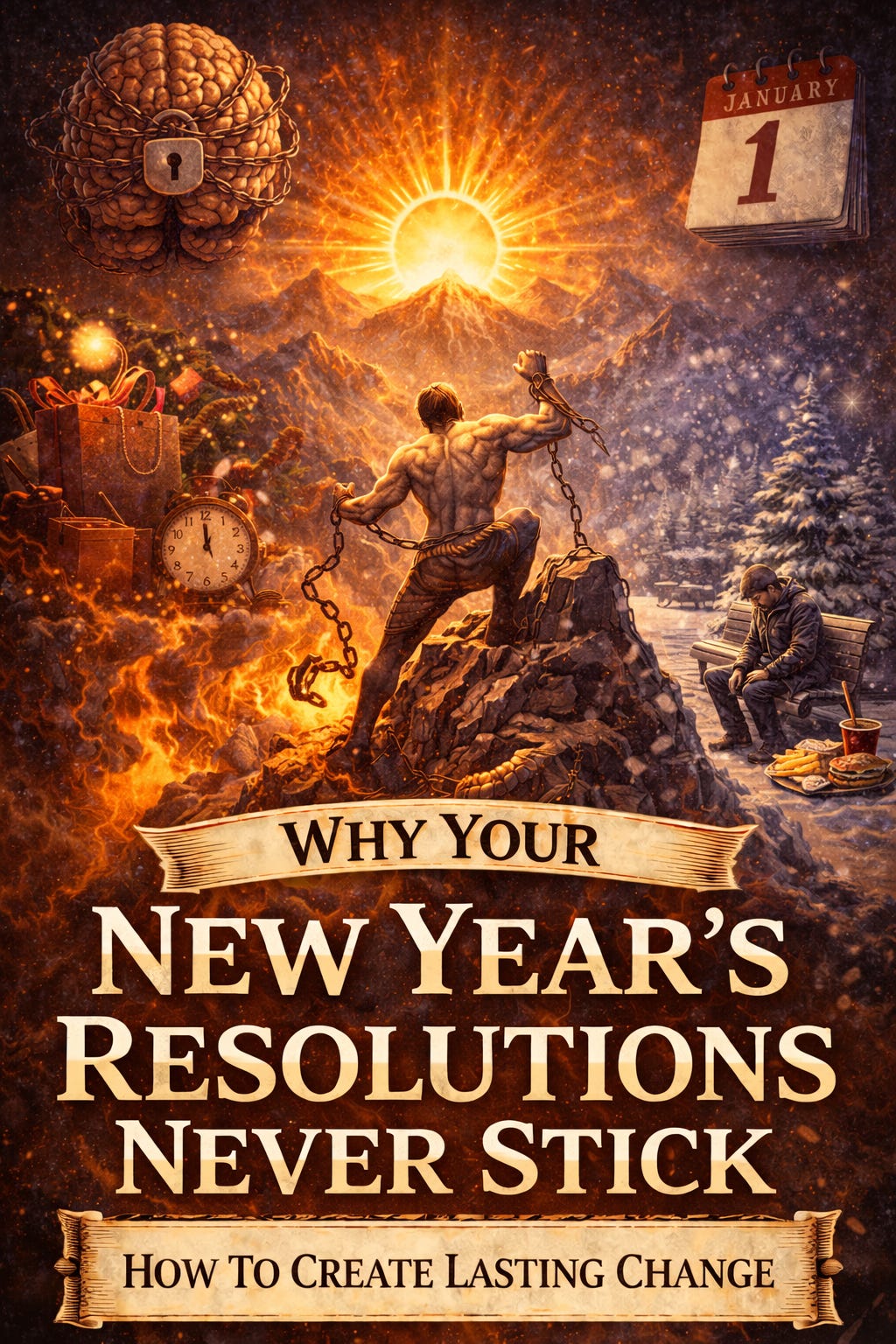
If you’re like most people, you’ve been setting New Year’s resolutions every year — for years, maybe decades — and most years, if not all, your inspired changes didn’t last more than a few months. Why? There are many reasons that we will dive into in this article, and we will wrap it up at the end with some solutions for you.
Most human beings live their lives mostly reacting to subconscious conditioning rather than conscious decision. I understand none of us want to admit this, but it’s true. It takes a great deal of self-awareness and practice to shift into a more awakened existence. Because of this lack of conscious self-awareness and decision-making, we look to society at large to show us how to be. This is why the masses participate in mass rituals — like national holidays — and easily fall into a state of mass hypnosis from marketing, entertainment propaganda, and observing the behavior of those around us. Setting New Year’s resolutions has become “what you’re supposed to do, to start the New Year right.”
Come January 1st, we are primed to follow the masses because cultural holidays have been systematically telling us how to act and what to do since October. Beginning in October — and for certain faiths, even earlier — marketing, entertainment, and social behavior are systematically showing us what to do, from Halloween, to Thanksgiving, to the grand finale of Christmas. Stores are inundated with decorations and holiday-related products; commercials on TV mirror the stores; and social media posters personalize the experience. For those of us who choose not to participate, it’s like swimming against the current in roaring rapids; for those who do participate, you are energetically, mentally, and emotionally depleted by the time you finally reach December 26th.
Even though we are completely exhausted — and have no business trying to make big life transformations right away — the herd nature ingrained into the internal operating systems of human beings is primed and fully activated. We look around, and everyone around us is boasting about their New Year’s resolutions; they seem so excited and confident — we can’t help but be inspired into our own excitement and confidence that we too can finally change that habit that has held us back for so many years. We somehow adopt a subconscious belief that the new year carries some kind of magical energy that we cannot access the rest of the year — when, in fact, the opposite is true.

Why Winter Is The Worst Time To Make Major Life changes
Heading into the peak of winter is the worst time to start making major life changes. The winter season is constantly working against us; this is even more so in certain regions. The Sun is our greatest source of energy. There is something called Seasonal Affective Disorder (SAD) — the “winter blues” are not random; they are biological.
During the winter season, we have less daylight; less access to our greatest energy source, the Sun. Though we only have a few hours less sunlight per day, the compound effect this has on us over three months is substantial. Neuroscience clearly explains why.
Light is not just visual — it is neurological input. Sunlight regulates the suprachiasmatic nucleus (SCN) in the hypothalamus, which controls circadian rhythms — circadian rhythms are directly responsible for regulating our sleep cycles.
Reduced daylight disrupts serotonin production and melatonin timing. Serotonin affects mood, motivation, and impulse regulation. Melatonin is responsible for our sleep/wake cycles. During these extended time periods with less sunlight — melatonin secretion lasts longer, serotonin activity is reduced, and alertness and motivated initiative drastically decline. Is this a good time for a couch potato to attempt becoming a gym rat? Is this a good time for someone who has subconsciously relied on comfort/junk food to soothe their stress to suddenly shift into a full-time healthy, clean diet?
Attempting to make major lifestyle changes during this time of year puts you in a position where you are in conflict against nature, and against yourself. You are trying to build a new identity while the brain is biologically nudged toward energy conservation and additional rest. To make permanent behavior changes, it requires you to have top levels of alertness, emotional regulation, and cognitive flexibility — you need the maximum amount of Sun exposure to fuel these attributes within you.
Even for those who do not clinically suffer from Seasonal Affective Disorder, most people still experience decreased initiative and drive, reduced pleasure, lower baseline mood, and increased emotional reactivity. Even without being clinically depressed, we are less resilient to friction during the winter. Because of our biological shifts during periods of less sunlight, even small obstacles feel disproportionately heavy. Is this really the best time for a weak body to start lifting weights?
In modern times, we have access to all the luxuries one could ask for — heated homes, vehicles for transport, and grocery stores stacked with food. It is crucial to understand there are parts of our brain and biology that have never adapted to modern comforts; the same operating system that our earliest ancestors used for survival is still a big part of our core operating systems today. Early Homo sapiens faced many hardships during the winter months — scarce food, basic shelters, intense cold exposure, and a much greater risk of death. To protect the human race, our collective physiology adapted to the winter by naturally conserving energy, increasing periods of rest, and reducing geographic exploration.
Cold exposure naturally increases caloric demands, encourages inward, self-preserving behavior, and creates a feeling of greater cost in regard to novelty and risk behavior. Big life changes require extended exploration, novelty, and new repeated behaviors in the face of unknown opposition.
What I find very interesting is that winter subtly increases background cognitive stress. It is almost imperceptible, but there are many changes as the weather transitions from warm to cold that add additional underlying stress. Now, if you live in a snowy environment, there is obvious added stress during the winter months. Even those of us who do not live in the snow are forced to make many minor life adjustments that compound into added stress: heavier winter clothes and layers, higher heating bills, firewood, more time indoors, and less spontaneous action. Even environmental changes — like places that were slow now being busy, and vice versa — contribute. These life changes subtly increase decision fatigue and undermine self-regulation, planning, and consistency in our behaviors and habits.
Have you ever noticed how you just feel overall less motivated during the winter? Motivation is largely driven by dopamine production; it responds to novelty, forward momentum, and anticipated reward. Winter brings a natural reduction in environmental novelty, sensory richness, movement variety, and outdoor social stimulation. This environmental reduction blunts reward anticipation and slows dopamine production in the brain. The reduction in dopamine makes future-oriented effort less compelling because it is anticipated to be less rewarding.
Our cultural pressure that has elevated January as the time for powerful life transformations has created a psychological mismatch within our collective consciousness. There is an annual clash between societal culture and human biology. We have nominated the calendar to become our life guide. Because the calendar shows that January brings us a new year, we have collectively assumed that this means the new year will naturally create a new you.
Culturally, January represents rebirth, reinvention, and momentum — biologically, the month favors rest, insulation, and conservation. If you buy into the collective mind-fuck of allowing the calendar to control your life, you are asking for a whole lot of cognitive dissonance to disrupt your mental state.

Why The Holiday Season Sets You Up To Fail In The New Year
Winter brings enough challenges as it is — then you add a three-month mass hypnosis ritual that ensures you will not be ready for major life changes in January. If you’re like most people, you allow yourself to be less disciplined from October to December; you sneak some of your children’s Halloween candy, you indulge in the seasonal coffee drinks sold at big-brand coffee retailers, you go all out on Thanksgiving Day consuming as much as your body will allow, and then in December you enjoy all the little sweet cookies and snacks throughout the month, and a massive meal on December 24th and/or 25th. You spend three months systematically weakening your body and your will, and then are expected to automatically shift long-held unhealthy life habits in January. Most people are at their weakest point of the year — physically, emotionally, and mentally — coming into January.
The fourth quarter of the fiscal year is the most profitable quarter for most retail-focused businesses. The cultural shift that begins to take place in early October is not accidental — it is engineered. Just as Q4 is the most profitable quarter for retailers, Q1 is the most profitable quarter for health, beauty, and personal development businesses — this New Year cultural shift is also purposefully engineered. Vultures of all industries feast on psychologically weakened consumers during the winter. The fall primes the meat, while the spring chews the leftover meat off the bones.
From early October through the end of the year, all cultural signals shift toward overconsumption, indulgence as virtue, disrupted sleep cycles, financial impulsivity framed as generosity, social obligation over self-regulation, and emotional eating encouraged by “comfort” narratives all around us.
These Q4 cultural shifts infiltrate all of our senses:
Visual cues: ads, decorations, and beautiful packaging
Social cues: “It’s the holidays, you deserve to let loose”; “You’ve been good all year, reward yourself”
Emotional cues: nostalgia, family obligations, “it’s the feel-good season,” time to spoil your children to show them your love
And on and on it goes — we smell the sweet baked goods in the air, we taste the goodies only enjoyed during the holidays, we hear the familiar holiday songs, we feel comforted in the cold weather by holding and sipping some hot cider, etc.
These are habit-forming rituals that are enacted every winter — the sensory cues are constant in varied environments, our internal reward systems are being instantly satisfied continuously, and social validation is exceptionally higher than it is during the other nine months of the year. These are formulas for forming addictions — most people do not consciously choose to celebrate the holiday season; they are subconsciously addicted to the rituals.
They say it takes twenty-one days to form a new habit; science largely disproves this — in reality, it is closer to forty days of reinforced behavior to create a new habit. Every year, the masses of society collectively experience twice this amount of time in a perpetual pattern of repeated sensory cues → habitual routines → reward loops.
During these final three months of the year, most people routinely snack more often and later in the evening, consume more sugar, drink alcohol more frequently, sleep irregularly, spend money impulsively, and then consume more mindless entertainment to help manage the stress on their internal operating systems. By the New Year, these routines have been cemented as lifestyle habits. These are no longer the conscious choices they were in early October; by early January, they have become automated responses.
All through November and December, the marketing subliminally repeats messages to let loose, indulge, pursue pleasure, you deserve this, and other hedonistic invitations — then on January 2nd the marketing takes a 180-degree turn and subliminally repeats messages to get disciplined, fix yourself, you are not good enough, you need to change, undo the damage you did to yourself during the holidays, you deserve to be a better version of yourself, and other messages of guilt and shame.
Are you understanding the massive mind-fuck they penetrate your mind, body, and soul with every single year, from your earliest childhood all the way to your dying day? They use your calendar as a weapon against you. Who is the captain of your life — you or your calendar?

Why You Cannot Avoid Habit Inertia
We must understand that habit inertia is a very real thing, and January propaganda ignores it. Newly formed habits have momentum. Recently reinforced behaviors have higher activation strength; your holiday-season habits are at peak strength in January. The old Q4 sensory cues still exist at a high level all the way through January 1st (another ritualistic day of overindulgence). Willpower and calendar dates alone cannot magically reverse these deeply ingrained behavioral loops.
One of the main reasons New Year’s resolutions fail for most people is because society teaches you to suppress habits rather than replace them. We fight the sensory cues rather than redesign our environments and lifestyle habits. We rely on motivation alone instead of learning how to reset our default internal operating systems.
January culture completely ignores the powerful effects of habit inertia. We cannot magically stop the momentum of our recently formed habits. Their natural trajectory will maintain its holiday direction and pace. We must practice patience and understand that as we start taking new actions to get “back to normal,” the holiday habit trajectory will slow down and lose momentum until it finally slows enough for us to form new habits and build their momentum in a new direction.
The whole system is engineered for you to fail and remain weak so you are easy to guide and sell to. The Q1 shame cycle feeds the entertainment, porn, and junk food industries through spring and summer. You set your New Year’s resolution on December 31st, you start strong for a few weeks, your old ingrained habits continue to dominate your inner systems, you quit by March and feel shameful — then you cope with your inner shame through escapism and hedonism: mindless entertainment, porn, promiscuous dating, and junk/comfort food.
You spend Q2 and Q3 doing your best to maintain the status quo of “who you normally are”; meanwhile, the cognitive dissonance caused by who you are compared to who you want to be is slowly breaking you down. Then October comes, and you slowly start giving yourself permission to stop fighting the unhealthy urges. Then the whole unconscious ritual repeats itself.
You spend the end of every year cultivating your worst habits, creating the worst version of yourself; you start the year with unrealistic expectations of becoming the best version of yourself; then you spend the middle of the year trying to maintain your “normal self.” And most of us run this same exact pattern year after year after year after year… until you wake up and stop allowing the external world to keep you in a perpetual state of hypnosis.
This may be offensive to the Pollyannas who might be reading this; our world is fucked. The main focus of mainstream culture is to train you to seek short-term rewards and temporary pleasures; then the same culture praises you when you show any amount of self-control and discipline. This is straight-up pimp psychology; seasonal marketing rewards indulgence for three months, shames you for the same behavior for three months, then offers conditional approval the rest of the year — the same psychology that keeps sex workers sacrificing their bodies also keeps the masses sacrificing their minds, bodies, and emotions all year long. They remain addicted to a cycle of relief-seeking and compliance.
It’s the same psychology that keeps people in abusive relationships: Q4 marketing trains indulgence through constant rewards and social permission; January reverses the frame, moralizing restraint and personal failure. The cycle — reward, shame, conditional approval — resembles coercive control, not because it’s identical, but because it exploits the same psychological levers.
This is not by accident! This is architected by corporate pimps who have studied and understand how human beings operate on a very deep level — and they use your friends and family as their strong pimp hand; when you get out of line, they backhand you right back into line with guilt, emotional pressure, and withdrawing love.
Consumers act like prostitutes, sacrificing their self-respect for worldly rewards; big corporations and advertising firms are masters in pimp psychology. Are we going to allow them to pimp us out, or are we going to stand strong and firm as self-respecting sovereign beings?

The Solution To Your Failed New Year’s Resolutions
So how do you successfully achieve your New Year’s resolutions? You don’t!
New Year’s resolutions are a joke; most people end up being the punchline. It is a small percentage of people who successfully achieve their New Year’s resolutions — and they probably have a huge “why” and a planned-out strategy to achieve what they’re aiming for. Most people declare their resolutions, rely on willpower, and then hope for the best.
I believe a great first step is to remove “New Year’s resolution” from your vocabulary and replace it with “permanent lifestyle change.” Goals rarely ever stick; you may achieve your goals short-term, but eventually your deep-seated subconscious conditioning comes back into control, especially when facing stressful times. The subconscious mind controls around 95% of who we are. It takes time, strategy, and consistency to reprogram your subconscious mind. Willpower and positive thinking alone are not enough to rewire years of faulty programming.
Lifestyle changes are long-term intentions and more naturally become permanent. Goals are something you achieve; lifestyle changes cultivate who you become.
It is best not to focus on the “doing”; focus on the “becoming.” When you imagine the lifestyle changes you intend to make, who do you need to become to match those changes? If your intention is to become a healthy person and you currently spend most of your free time on the couch watching screens, what does the healthy version of you do in his or her free time?
The life you live now is the life you are emotionally, psychologically, physically, and vibrationally a match for. What is the emotional landscape that matches your new life? What is the psychological profile? What is the necessary physique to keep up with your new life? When you improve these three aspects of yourself, your vibrational energy will rise to a level that matches higher-vibrational things…
Which vibrates at a higher level — sitting on the couch or being outside walking? Living in a poor neighborhood or in a nice neighborhood by the beach? Listening to obscene rap or rock, or classical music? Watching mindless entertainment filled with sex, adultery, and violence, or documentaries that teach you to grow? Complaining about your life or asking yourself how you can improve your circumstances?
Your thoughts, words, and habits affect your vibrational frequency and what you attract into your life. Personally, I believe focusing on Christ greatly helps keep us at higher vibrational frequencies; if that’s not where your beliefs are at, what can you focus on that aligns you with a higher vibrational frequency?
It is also important to understand that your subconscious mind does not process negatives. There is abundant evidence from scientific studies that show positively focused changes are more effective than negatively focused changes…
Rather than telling yourself, “I will stop eating unhealthy foods,” instead tell yourself, “I will eat primarily healthy foods every day”; or even better yet, “I am a person who consistently eats healthy foods and exercises regularly.” Focus your thoughts on the self you need to be to match the life you want to live; focus on what you’re going to be doing, not what you need to stop doing. There is a universal principle that says, “what you focus on expands” — focus on what you intend to change in a positive frame.
One of the most important elements to successfully implementing permanent lifestyle changes is being clear about, and writing down, your “why.” When you clearly know why you are making lifestyle changes, you will have that added excitement and inner fuel to push through obstacles. If you are unable to get clear on your “why,” then maybe you should reevaluate whether these changes are worth the effort.
Lastly, don’t begin implementing your new lifestyle changes in January. Take Q1 slow and flow with the winter season — resting, moving slowly, and recovering from the holiday season. Then, in the spring, the true seasonal time of renewal, start making concerted efforts to form your new habits. This also gives you enough time to make them deeply ingrained, so you have a better chance of resisting Q4’s many temptations and cultural pressures to maintain the new you. Few things have greater power to snap a person back into their former self than the holiday season — the first Q4 will be challenging; once you stay strong the whole three months, each holiday season gets easier and easier until eventually you’re no longer affected at all.
Only focus on one or two major life changes at a time. When you try to change too many things at once, it takes you way too far outside your comfort zone; very few people can handle that level of consistent discomfort.
Know that you aren’t going to make major permanent shifts overnight. This is a long-term intention. There will inevitably be ups and downs. For most people, their journey will begin with one step forward, then two steps back — then two steps forward, one step back — eventually your natural movement will be three steps forward; then you take on the next life transformation.
Give yourself a few weeks as a ramp-up period — within a few weeks or a couple of months, you will be at a consistent two-steps-forward pace. Stay sturdy there for forty or more days to permanently make the subconscious transformation, and then confidently strut with your three steps forward.
Understand that it is natural and okay to backslide in the beginning. The key is to not lose hope and to keep your mind’s eye focused on that future version of yourself living the lifestyle you intend to live. Come back to your “why” often: “I am continuing to move forward in the face of adversity because…” What happens to some people is they focus on perceived “failures” or on it “not happening fast enough”; then they start losing hope — two steps forward quickly become one step forward, two steps back — then three steps back, and they surrender into giving up on self-improvement and go back to numbing their pain and shame through hedonism and escapism.
Enjoy your winter rest, and begin strategizing your “spring forward” launch. Take the New Year time to visualize who you intend to become in 2026, and write it down. Look at the changes you will make — one at a time — next year; write them down and describe in detail who you need to be to vibrationally, emotionally, psychologically, and physically match your new lifestyle.
Have a blessed 2026 and beyond! I am excited for you to meet the new you next year — and the newer you in the years that follow!!

Makes perfect sense. I have never liked the commercialized holidays and opted out for years. Then, I got sucked in again, unhappily hypnotized, but not totally. I needed this reminder. Thank you.
Porca Miseria! The best is to never have being born(SILENO dixit).